







Marcos reactivates El Niño task force amid worsening dry spell


At A Glance
- The task force will be chaired by the Department of National Defense (DND) secretary, while the secretary of the Department of Science and Technology (DOST) shall serve as the co-chairperson.
- The task force is tasked to revise and update, if necessary, the Strategic El Niño National Action Plan, which is the comprehensive disaster preparedness and rehabilitation plan for the El Niño phenomenon.
- Marcos ordered the task force to coordinate with relevant government agencies to expedite the completion of water infrastructure projects to cushion or mitigate the impacts of El Niño before May 2024.
President Marcos has ordered the reactivation of Task Force El Niño to come up with solutions to ensure food, water, and energy security amid the worsening dry spell, which is projected to last until the year's second quarter.
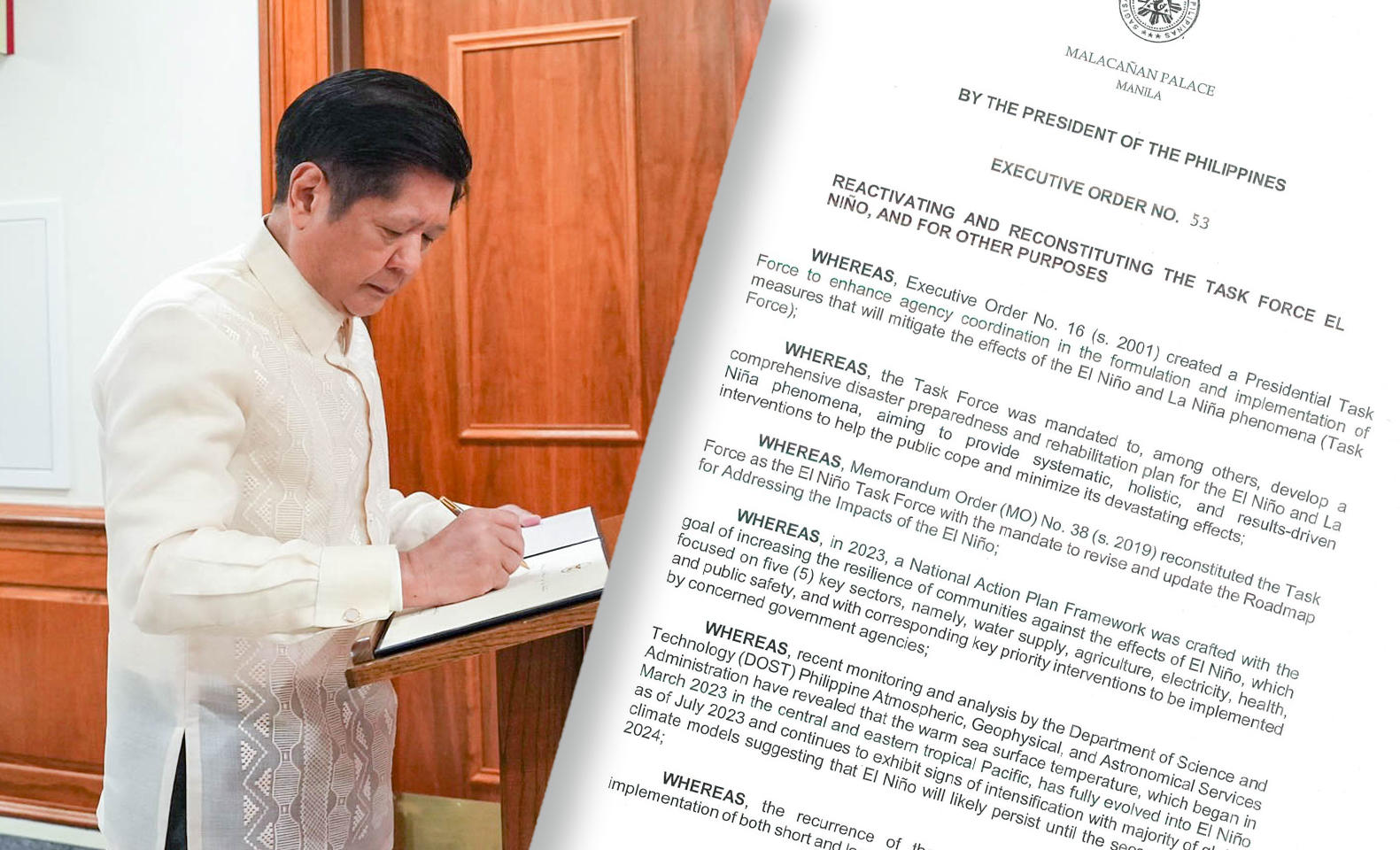
Marcos gave the order via Executive Order (EO) No. 53, signed by Executive Secretary Lucas Bersamin on Jan. 19, 2024.
The EO came after President Marcos ordered government agencies to accelerate the implementation of the Government Energy Management Program (GEMP) to conserve energy to minimize the effects of El Niño in the country.
In his EO, released on Monday, Jan. 22, the President cited studies from the Philippine Atmospheric, Geophysical, and Astronomical Services Administration (Pagasa) that show that the warm sea surface temperature continues to intensify.
"The recurrence of the El Niño phenomenon calls for the implementation of both short- and long-term solutions to ensure food, water, and energy security, safeguard livelihoods, and improve the country's disaster and climate resilience," Marcos said.
With this, the Chief Executive ordered the reactivation and reconstitution of Task Force El Niño under the Office of the President. It will be chaired by the Department of National Defense (DND) secretary, while the secretary of the Department of Science and Technology (DOST) shall serve as the co-chairperson.
Joining the task force as members are the secretaries of the Department of Environment and Natural Resources (DENR), the Department of Agriculture (DA), the Department of Health (DOH), and the National Economic and Development Authority (NEDA).
The task force is tasked to revise and update, if necessary, the Strategic El Niño National Action Plan, which is the comprehensive disaster preparedness and rehabilitation plan for the El Niño phenomenon.
It is directed to monitor the implementation of the short- and long-term solutions and programs identified in the said action plan, especially on water, food, and energy security; health; and safety.
Marcos ordered the task force to coordinate with relevant government agencies to expedite the completion of water infrastructure projects to cushion or mitigate the impacts of El Niño before May 2024.
In coordination with the Presidential Communications Office, the task force shall conduct an information campaign to educate the public about the El Niño phenomenon and the necessary interventions to reduce its adverse impact on the country.
The group, in coordination with the Department of Information and Communications Technology (DICT), shall establish the El Niño Online Platform, which shall serve as the centralized repository for El Niño-related data, research, and information, such as relevant plans and programs.