







Tajikistan makes more history to join Australia in Asian Cup quarters


At A Glance
- Asian Cup debutant Tajikistan celebrated making more history as it stunned the United Arab Emirates on penalties to join Australia in the quarterfinals on Sunday, Jan. 28.
DOHA (AFP) -- Asian Cup debutant Tajikistan celebrated making more history as it stunned the United Arab Emirates on penalties to join Australia in the quarterfinals on Sunday, Jan. 28.
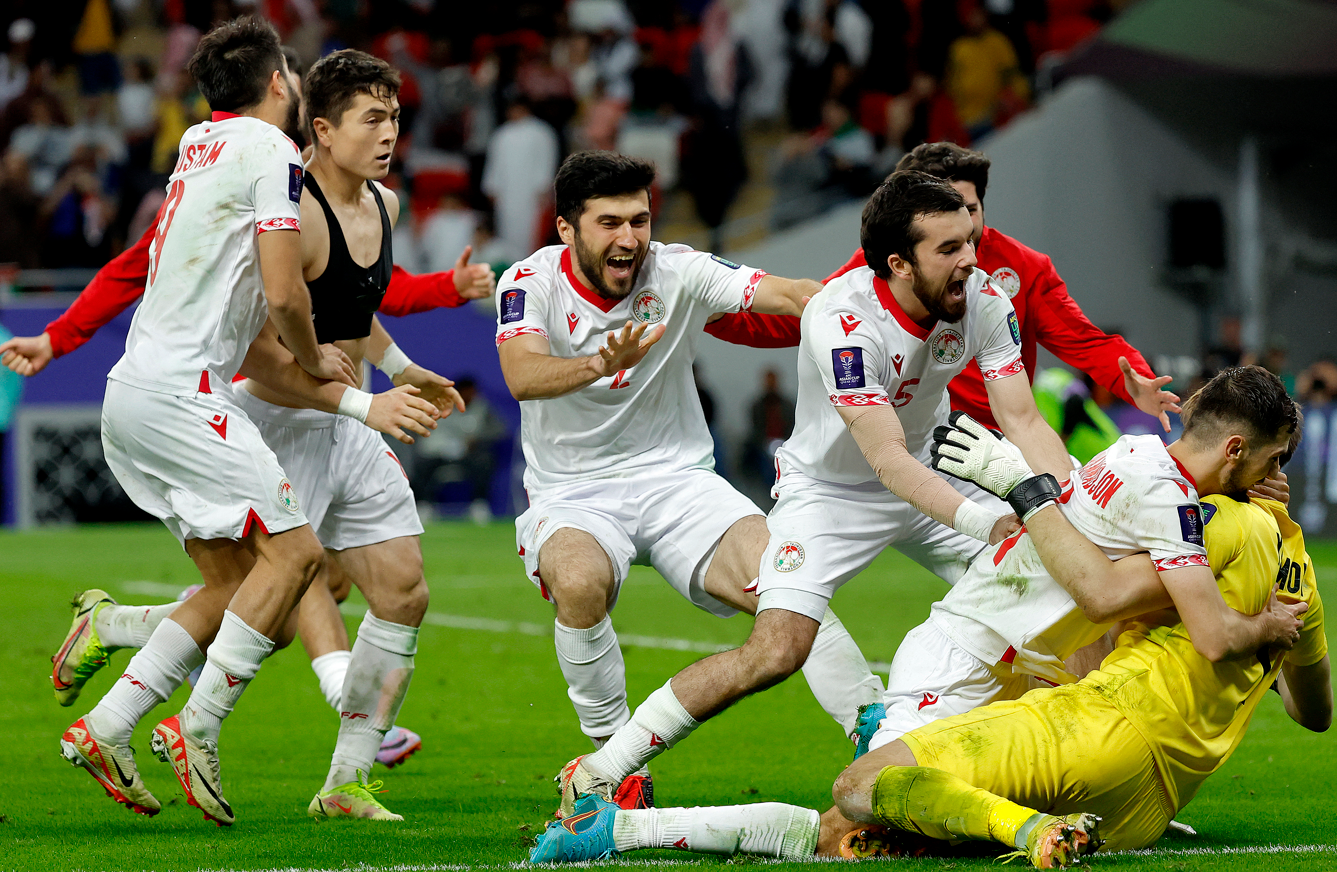
After the game ended 1-1 in Doha following 120 tense minutes, Tajikistan won a dramatic shootout 5-3 with Alisher Shukurov holding his nerve with the final spot-kick.
The Central Asians, ranked 106th in the world and at their first Asian Cup, will now face either Jordan or the 2007 champions Iraq in the last eight.
Goalkeeper Rustam Yatimov made the decisive save from Caio Canedo with the UAE's second penalty of the shootout, and his outfield teammates did the rest.
Tajikistan's charismatic Croatian coach Petar Segrt called his team "the black horses of the tournament" and said "nobody knows how far we can go".
"I have no limits for the players because every game they surprise me again," he said.
"My next dream is to go to the next round again. I think in Tajikistan tonight, nobody will sleep."
Tajikistan had looked set for a famous victory in normal time when Vakhdat Khanonov scored with a 30th-minute header, only for Khalifa Al-Hammadi to equalize in the 95th minute and send the game into extra-time.
"I dedicate this goal to my brother who passed away," the defender Khanonov said.
"He is not with us and can't see my happiness."
The UAE reached the semifinals at the last two Asian Cups but Paulo Bento's side bow out to a side ranked more than 40 places lower than them.
Tajikistan drew with China and beat Lebanon in the first round to advance as Group A runners-up.
They will learn who they play in the quarterfinals when Iraq takes on Jordan in the last 16 on Monday.
Palestine will make its debut in the knockout rounds when it face host and holder Qatar in Monday's second game of the day.
Australia thrashes Indonesia
Australia set up a tasty clash against South Korea or Saudi Arabia in the last eight with a 4-0 win over a spirited but limited Indonesia.
The Socceroos are trying to win the title for a second time and were again solid rather than spectacular in getting the job done in a niggly encounter.
Two goals in the first half, a deflected own goal on 12 minutes and a diving header by Martin Boyle on the stroke of the break, put Graham Arnold's side on their way.
With Indonesia out of gas at the end, Craig Goodwin volleyed in a rebound on 89 minutes for 3-0 and defender Harry Souttar made it four in stoppage time.
The scoreline flattered Australia but it was their third clean sheet in four matches and they have conceded only once.
"Indonesia made it tough for us, physically they were very big and strong," said coach Arnold.
"We told the boys to be ready for a fight and a physical battle."
Indonesia was making its first appearance in the knockout rounds of the competition and was ranked 121 places below its opponents.
They only conjured one shot on target all game but their South Korean coach Shin Tae-yong felt 4-0 was harsh on his side, who gave Australia one or two nervy moments in the first half.
"If we had not conceded this unlucky deflected first goal maybe things could have been different," he said.
"We did not play badly and regardless of the four goals, I want to thank my players."