






 Philippines
Luzon
Mayor lauds Bago City softbelles for topping 2023 Junior League World Series
Philippines
Luzon
Mayor lauds Bago City softbelles for topping 2023 Junior League World Series
Mayor lauds Bago City softbelles for topping 2023 Junior League World Series


BACOLOD CITY – Historic day.
Thus said Mayor Nicholas Yulo after the Bago City Junior League Softball team bested seven other regions in the 2023 Junior League World Series championship in Kirkland, Washington, United States over the weekend.
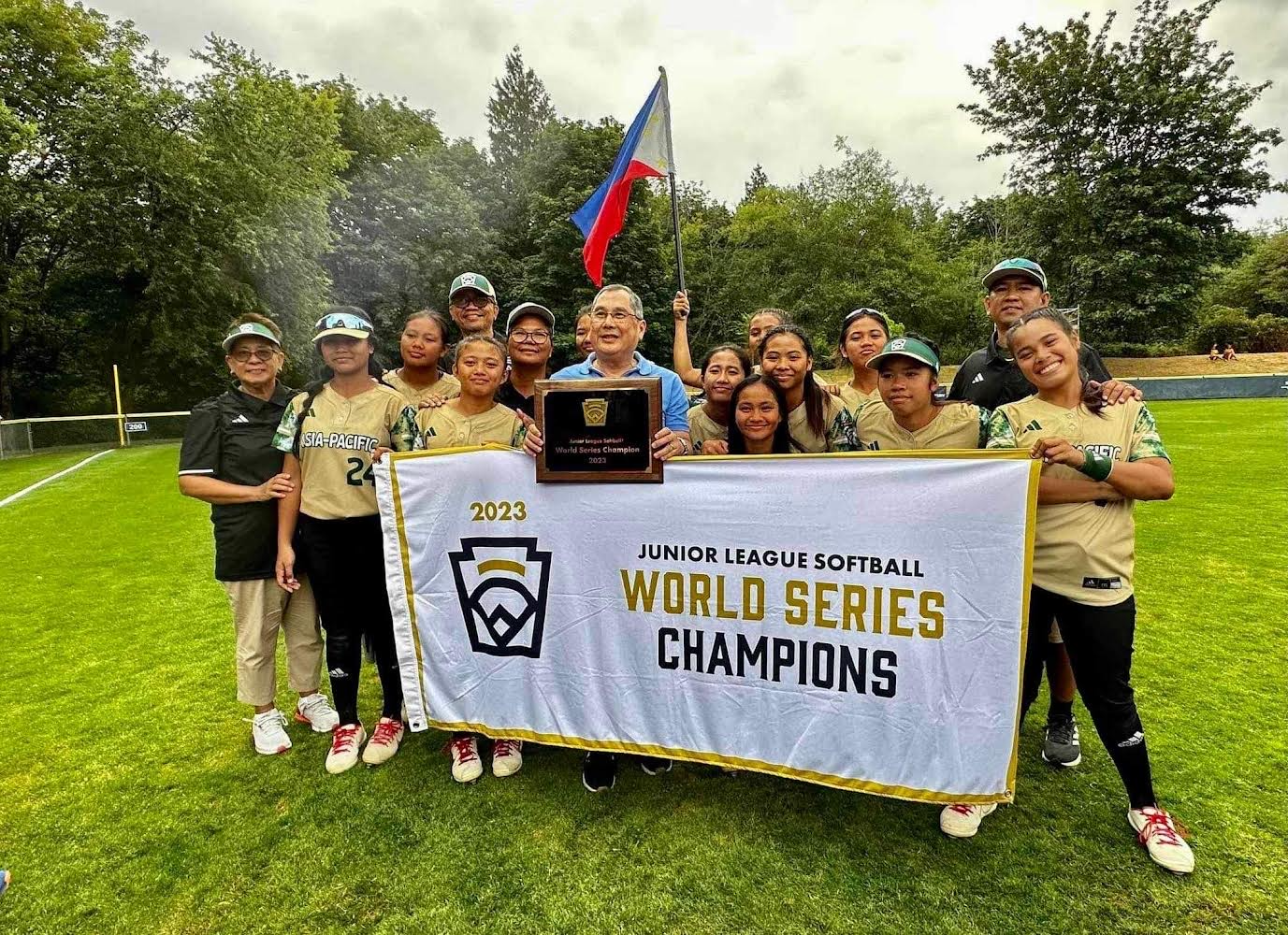
BAGO City, Negros Occidental Mayor Nicholas Yulo with the Bago City Junior League Softball team after winning the 2023 Junior League World Series championship in Kirkland, Washington, United States over the weekend. (Contributed photo via The Citybridge)
“This was a historic day for Bago City,” Yulo, who accompanied the team during the competition, said.
“For the first time, the Bagonhon team was able to clinch the Junior League Softball World Series championship,” the mayor added.
Yulo lauded the Bago City Softball Girls "for a job well done and for the honor they brought to the city and the whole country."
“This is indeed a victorious day for Bago City and the Philippines,” he said.
The mayor hoped that the team's triumph will inspire young Bagonhons to aim high and dream bigger.
The Philippine team composed of the Ramon Torres National High School (RTNHS) softbelles lifted the Asia-Pacific region to a 3-0 victory over Eastern Region in the final.
Erica Arnaiz struck out 15 batters and Ann Dyana Buenafe recorded two runs batted in (RBIs) to lead the country past Connecticut.
The team barged into the final after beating District 9 Region (Washington) 19-0, Southeast (Florida) 4-1, Canada Region (Canada) 7-4, Central Region (Michigan) 10-0, West Region (Arizona) 4-0, and Southwest Region (Texas) 4-0.
Other team members were Icelle Tanaman, Ashley Ortiz, Froline Manalo, Cristine Jane Caracas, Daniela Bejos, Audrie Sarsona, Thereze Francine Fuentes, Mary Antoinette Sicapore, Nice Lobrido, and Casandra Sumatra.
They were coached by Rolando Fuentes and Leo Dayot and trained by Josie Sebunga and Sarah Caracas.
The mayor acknowledged the participation of Francis Fuentes, who stepped up to be the team manager and head coach, and the commitment of Rey Fuentes as team founder.
Yulo thanked the parents and family for their relentless support of their children.
Last year, the team finished third place in the competition.