







Dodgers eye back-to-back titles with Ohtani returning to mound in 2025


At A Glance
- Ohtani's former interpreter is on his way to jail on bank and tax fraud charges when he's sentenced in December. Ohtani is going back to being a two-way sensation next year when he resumes pitching after he spent this season recovering from a second elbow surgery.
- <br>
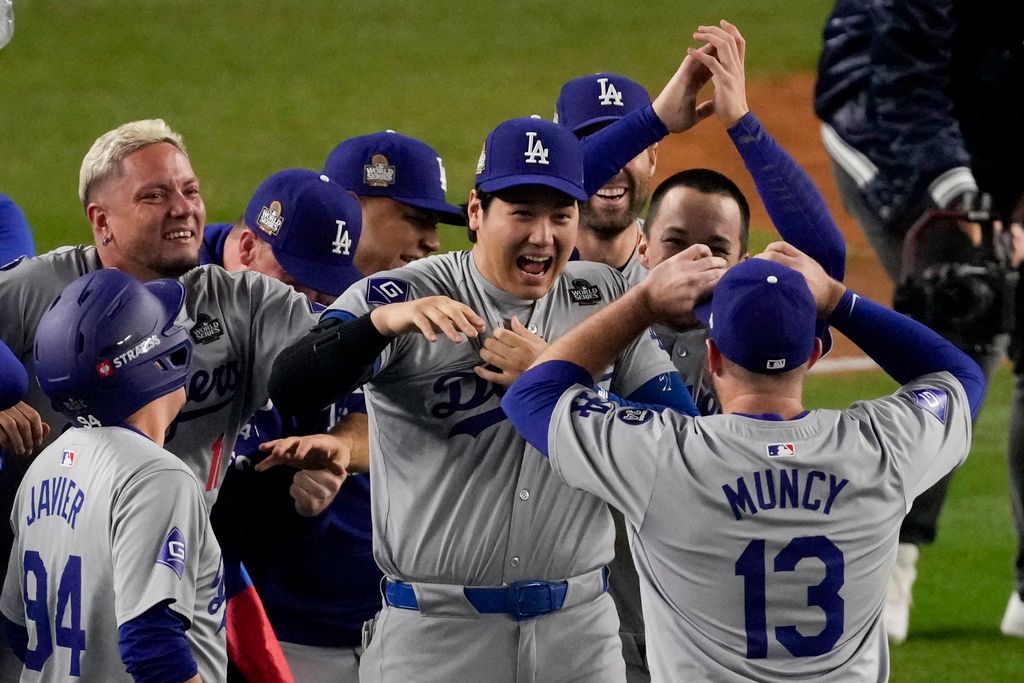
LOS ANGELES (AP) — The Los Angeles Dodgers’ first game of the season in South Korea was overshadowed afterward by Shohei Ohtani’s interpreter hinting at his stealing from the Japanese superstar. Their last postgame was a beer and champagne-fueled celebration of the franchise’s eighth World Series title.
In between came a multitude of injuries, especially to the rotation as well as Mookie Betts’ broken hand and Freddie Freeman’s sprained ankle, Ohtani’s historic 50/50 feat, the franchise’s 11th National League West title in 12 seasons, and compiling the best record in the majors.
Then came the playoffs, where the Dodgers proved a resilient bunch.
They trailed rival San Diego 2-1 in the National League Division Series and rallied to win in five games.
They were pushed to six games in the NL Championship Series by the New York Mets before advancing.
They were about to lose the World Series opener until Freeman delivered the first walk-off grand slam in Series history. They ran through eight pitchers to eke out a 7-6 victory over the New York Yankees to close out the Series in five games.
“We just kept going. Even in the postseason, I don’t think anyone had us picked. I don’t think they had us picked to get out of the first series,” manager Dave Roberts said. “For us to go out there and fight and scratch and claw and win 11 games in October, that’s a credit to our guys.”
Investing a billion dollars to acquire Ohtani and fellow Japanese player Yoshinobu Yamamoto last offseason certainly paid off, even if Ohtani’s playoff performance didn’t match what he did during the regular season when his offense carried the Dodgers.
Ohtani reached career highs in home runs, stolen bases and RBIs and is the favorite to win NL MVP honors. In the playoffs, he went 2 for 19 with no RBIs and had one single after partially dislocating his shoulder in Game 2 of the World Series.
“What Shohei’s done to our ball club, the Dodger fan base domestically, globally, I just don’t think you can quantify,” Roberts said. “He was playing with one arm in the postseason. So most guys would probably tap out, but he was going to not be denied at playing and posting and being in the lineup.”
The Dodgers made some key pickups at the July trade deadline, including pitchers Jack Flaherty — who was one of three healthy starters in the playoffs — and Michael Kopech as well as utilityman Tommy Edman, whose offense in the NLCS earned him MVP honors.
Ohtani’s former interpreter is on his way to jail on bank and tax fraud charges when he’s sentenced in December. Ohtani is going back to being a two-way sensation next year when he resumes pitching after he spent this season recovering from a second elbow surgery.
The Dodgers have eight players who became free agents when the World Series ended: Walker Buehler, Flaherty, Kiké Hernández, Teoscar Hernández, Daniel Hudson, Joe Kelly, Kevin Kiermaier and Blake Treinen.
Hudson announced his retirement after Wednesday night’s victory, while Kiermaier had already said he planned to retire.
The Dodgers hold team options on Austin Barnes and Miguel Rojas for next season. Clayton Kershaw has a player option and has said he plans to be back after a toe injury kept him out of the playoffs.
But for now the celebration continues.
After winning a neutral-site World Series against Tampa Bay in 2020 and being denied a parade because of the coronavirus pandemic, the Dodgers have pent-up energy to burn.
“I’m sure there’s no asterisk on this one,” Roberts said.
They will commemorate their championship with a downtown parade and Dodger Stadium celebration on Friday, which would have been Fernando Valenzuela’s 64th birthday. The 1981 NL Cy Young Award and Rookie of the Year winner died last week.
“It’s going to be emotional,” said Roberts, who was friends with Valenzuela. “I know he’s smiling right now and very proud of this organization.”