






 Sports
Boxing
Canelo Alvarez wins unanimous decision in dominating title defense against Edgar Berlanga
Sports
Boxing
Canelo Alvarez wins unanimous decision in dominating title defense against Edgar Berlanga
Canelo Alvarez wins unanimous decision in dominating title defense against Edgar Berlanga


At A Glance
- Making his eighth super middleweight title defense, the 34-year-old Alvarez (61-2-2) dominated much of the fight, using his experience and tenacious pursuit to wear down the 27-year-old challenger, frequently sending 20,312 fans into a frenzy, often chanting "Mexico! Mexico!" or "CA-NEL-O! CA-NEL-O!"
LAS VEGAS (AP) — Super middleweight champion Saul “Canelo” Alvarez outpointed challenger Edgar Berlanga on Saturday night, Sept. 14, in front of a sold-out crowd at T-Mobile Arena.
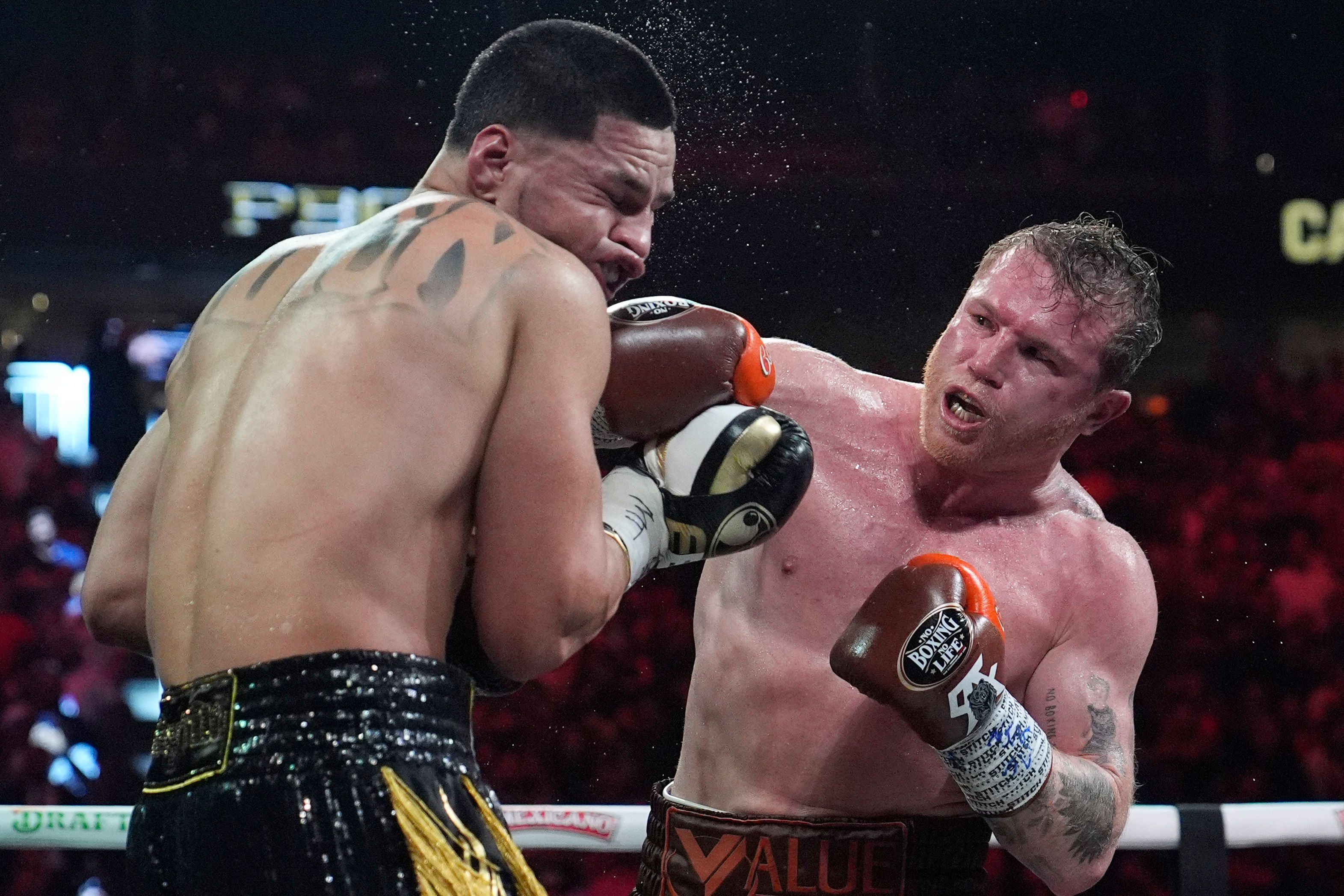
Making his eighth super middleweight title defense, the 34-year-old Alvarez (61-2-2) dominated much of the fight, using his experience and tenacious pursuit to wear down the 27-year-old challenger, frequently sending 20,312 fans into a frenzy, often chanting “Mexico! Mexico!” or “CA-NEL-O! CA-NEL-O!”
Berlanga lost for the first time in his career, dropping to 22-1-0.
“I did good. Now what are they going to say? They said I don’t fight young fighters,” Alvarez said. “They always talk, but I’m the best fighter in the world.”
Judges Max DeLuca and Steve Weisfeld scored the fight 118-109, and judge David Sutherland had it 117-110.
Berlanga almost matched Alvarez’s punch output, but the champion was much more accurate. Alvarez landed 43.3% (201 of 464) of the punches he threw, while Berlanga connected on just 119 of 446 (26.7%). Alvarez also landed 49.1% (133 of 271) of his power punches.
Alvarez, a four-division champion, still hasn’t ended a fight early since scoring a technical knockout of Caleb Plant nearly three years ago, when he became the undisputed champion.
It appeared that drought might end when a sharp left hook to the chin dropped Berlanga in the third round, and further punishment from Alvarez seemed to be taking a toll. Alvarez landed a crisp right uppercut in the fifth and a vicious hook in the sixth.
But Berlanga wouldn’t go away, as he stood toe to toe and matched Alvarez’s machismo, refusing to be bullied by the man he’d call “my idol” after the fight. He also got wild in the seventh, missing a wild overhand right that caused him to fall on the canvas, and was warned for a headbutt to Alvarez’s face in the eighth round.
“I got a little angry with his tactics, but I’m Mexican man,” Alvarez said. “It means a lot to fight on this day. It’s an honor to represent my country on this day.”
It marked one of the biggest nights in combat sports on Mexican Independence Day for Las Vegas, as the UFC made its debut at the Sphere, just three miles down Las Vegas Boulevard, with seven Mexican fighters in the lineup.
Alvarez closed as a -1600 favorite at BetMGM Sportsbook, which means a bettor would have had to wager $1,600 to win $100.
The IBF removed Alvarez’s title after he chose to fight Berlanga rather than fight its No. 1 challenger, William Scull.
In a very uneventful WBA middleweight championship bout, 41-year-old Erislandy Lara (31-3-3) successfully defended his title against Danny Garcia (37-4-0) with a TKO at three minutes of the ninth round thanks to a straight left jab to the face. Garcia’s father and trainer, Angel, requested the stoppage after the round.
“The punches I was landing were hurting him,” said Lara, the oldest active world champion in boxing. “That punch that ended the fight was a big shot.”
After falling behind on the scorecards early during a fight for the interim WBA super middleweight belt, Caleb Plant overcame being knocked down in the fourth, dominated the last four rounds, and earned a ninth-round TKO of Trevor McCumby (28-1-0). With time winding down, Plant unleashed a flurry of punches to McCumby’s head that prompted referee Allen Huggins to stop the bout at the 2:59 mark.
“I knew I had him hurt and had to go to work,” Plant said. “It was time to get my belt. Now I’m ready to go home and play with my daughter.”
In the first fight of the main card on the pay-per-view event, Rolando Romero improved to 16-2-0 with a unanimous decision over Manual Jaimes (16-2-1), with all three judges scoring the fight with identical scores, 99-91.