

ADVERTISEMENT

BSP, 4 other central banks, prepare for Nexus live implementation

Published Jul 1, 2024 07:25 am

Five central banks including the Bangko Sentral ng Pilipinas (BSP) have completed the comprehensive blueprint for the Nexus Project, a global effort to connect domestic instant payment systems (IPS), and paving the way for its live implementation.

In a joint statement Monday, July 1, the BSP and four other central banks including the Central Bank of Malaysia, the Monetary Authority of Singapore, the Bank of Thailand and the Reserve Bank of India announced that since the extensive blueprint for Phase Three of Project Nexus is done, all work are now focused on the next stage of “seamlessly connecting” their respective IPS.

It was BSP, Central Bank of Malaysia, the Monetary Authority of Singapore and the Bank of Thailand with domestic IPS operators who worked together in phase three.

The Nexus, which is a prototype developed by the Bank for International Settlements (BIS) Innovation Hub Singapore Centre with the central banks of Italy, Malaysia and Singapore, connects payment system operators with the Eurosystem’s TARGET Instant Payment Settlement (TIPS), Malaysia’s Real-time Retail Payments Platform (RPP) and Singapore’s Fast and Secure Transfers (FAST).

The next stage is that BSP, Central Bank of Malaysia, the Monetary Authority of Singapore and the Bank of Thailand will now be joined by the Reserve Bank of India with its IPS, the Unified Payments Interface (UPI), the world’s largest IPS.

Meanwhile, Bank Indonesia which took part in Phase Three will continue with the project with special observer status.
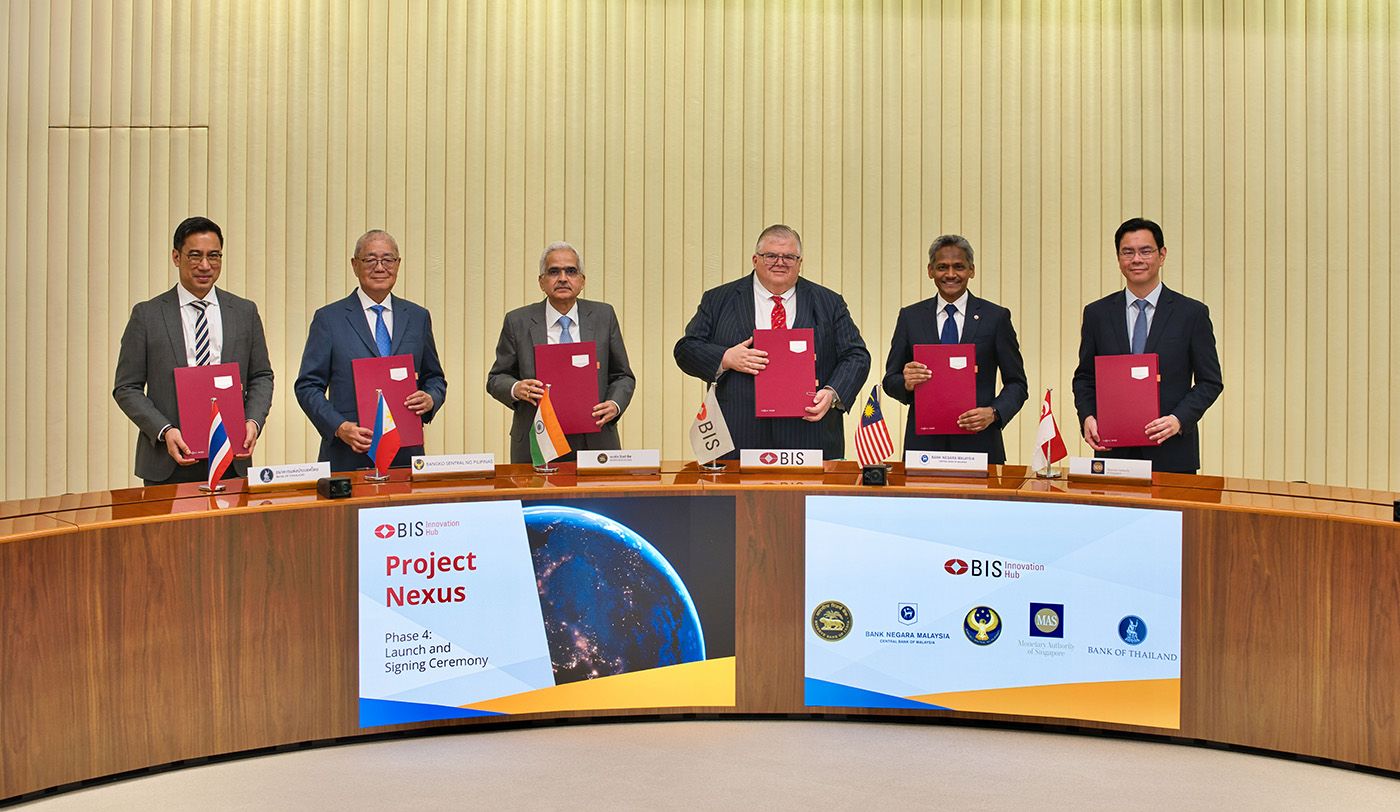
image003.jpg
Project Nexus Phase 4 Launch and Signing Ceremony held at Basel, Switzerland on 30 June 2024. Photo shows (from left) Governor Sethaput Suthiwartnarueput of Bank of Thailand, Governor Eli M. Remolona Jr. of Bangko Sentral ng Pilipinas, Governor Shri Shaktikanta Das of Reserve Bank of India, General Manager Agustín Carstens of Bank for International Settlements, Governor Datuk Abdul Rasheed Ghaffour of Bank Negara Malaysia, and Managing Director Chia Der Jiun of Monetary Authority of Singapore


BSP Governor Eli M. Remolona Jr. said Monday that the BSP will continue to work with the Philippine payments industry, the BIS and other interested countries in the live implementation of the Nexus Project.

“Empowered by a shared vision of efficient and reliable cross-border payments, the collaboration between the BIS and ASEAN central banks has been rather effective, and I’d like this to continue,” he said.

He added that the other central banks “have always played a role in payments as a public good (and) with Nexus, this role will be extended to cross-border payments, maximizing the network effects.”

Remolona also said that he looks forward to Nexus as “providing overseas Filipinos with a cheaper and faster means to send money to family back home, and facilitating the globalisation of Filipino small and medium scale enterprises.”

In the Philippines, the BSP has the PESONet and InstaPay under the National Retail Payment System which was launched in 2017.

PESONet enables high-value transactions and may be considered as an electronic alternative to the paper-based check system. InstaPay is a real-time, low value electronic fund transfer facility for transactions up to P50,000 and is most useful for remittances and e-commerce.

As the central banks involved work towards its live implementation, the BIS will facilitate central banks and IPS operators of India, Malaysia, the Philippines, Singapore and Thailand in the next phase.

The BSP said the Nexus Project has standardized the way domestic IPS connect to one another. Rather than an IPS operator building custom connections for every new country to which it connects, the operator only needs to make one connection to Nexus, it explained. “This single connection would allow the IPS to reach all other countries in the network,” said the BSP.

BIS General Manager Agustin Carstens said the Nexus Project has the potential to connect a market of 1.7 billion people globally and “allowing them to make instant payments to each other easily and cheaply.”

“This is the first BIS Innovation Hub project that central banks are moving towards a live phase together with instant payment providers. When implemented, it will greatly enhance cross-border payments in line with both the G20 cross-border payments programme and our mission to develop public goods in the technology space to support central banks and improve the functioning of the financial system,” said Carstens.

To facilitate live implementation, the partner central banks and IPS operators have agreed to work towards establishing a new entity, the Nexus Scheme Organisation (NSO), which will be responsible for managing the Nexus scheme, and continuing the mission to achieve instant cross-border payments at scale, said the BSP.

The BSP also noted that the NSO will be wholly owned by the central banks and the IPS in participating countries, depending on the specific domestic structures.

“While the BIS will not own or operate the NSO, it will continue its support by playing a technical advisory role as participating countries work towards taking Nexus live. It will also facilitate cooperation among members and the entry of new participants, helping to realise Nexus’s global ambition,” said the BSP.

Based on a November 2022 Memorandum of Understanding on Cooperation in Regional Payment Connectivity, the BSP, Bank Indonesia, Central Bank of Malaysia, the Monetary Authority of Singapore and the Bank of Thailand will leverage experiences from Phase One and Phase Two of the Nexus Project to connect IPS and facilitate cross-border transactions for some 500 million people in the region.


ADVERTISEMENT
.most-popular .layout-ratio{ padding-bottom: 79.13%; } @media (min-width: 768px) and (max-width: 1024px) { .widget-title { font-size: 15px !important; } }

{{ articles_filter_1561_widget.title }}

.most-popular .layout-ratio{ padding-bottom: 79.13%; } @media (min-width: 768px) and (max-width: 1024px) { .widget-title { font-size: 15px !important; } }

{{ articles_filter_1562_widget.title }}

.most-popular .layout-ratio{ padding-bottom: 79.13%; } @media (min-width: 768px) and (max-width: 1024px) { .widget-title { font-size: 15px !important; } }

{{ articles_filter_1563_widget.title }}

{{ articles_filter_1564_widget.title }}

.mb-article-details { position: relative; } .mb-article-details .article-body-preview, .mb-article-details .article-body-summary{ font-size: 17px; line-height: 30px; font-family: "Libre Caslon Text", serif; color: #000; } .mb-article-details .article-body-preview iframe , .mb-article-details .article-body-summary iframe{ width: 100%; margin: auto; } .read-more-background { background: linear-gradient(180deg, color(display-p3 1.000 1.000 1.000 / 0) 13.75%, color(display-p3 1.000 1.000 1.000 / 0.8) 30.79%, color(display-p3 1.000 1.000 1.000) 72.5%); position: absolute; height: 200px; width: 100%; bottom: 0; display: flex; justify-content: center; align-items: center; padding: 0; } .read-more-background a{ color: #000; } .read-more-btn { padding: 17px 45px; font-family: Inter; font-weight: 700; font-size: 18px; line-height: 16px; text-align: center; vertical-align: middle; border: 1px solid black; background-color: white; } .hidden { display: none; }
function initializeAllSwipers() { // Get all hidden inputs with cms_article_id document.querySelectorAll('[id^="cms_article_id_"]').forEach(function (input) { const cmsArticleId = input.value; const articleSelector = '#article-' + cmsArticleId + ' .body_images'; const swiperElement = document.querySelector(articleSelector); if (swiperElement && !swiperElement.classList.contains('swiper-initialized')) { new Swiper(articleSelector, { loop: true, pagination: false, navigation: { nextEl: '#article-' + cmsArticleId + ' .swiper-button-next', prevEl: '#article-' + cmsArticleId + ' .swiper-button-prev', }, }); } }); } setTimeout(initializeAllSwipers, 3000); const intersectionObserver = new IntersectionObserver( (entries) => { entries.forEach((entry) => { if (entry.isIntersecting) { const newUrl = entry.target.getAttribute("data-url"); if (newUrl) { history.pushState(null, null, newUrl); let article = entry.target; // Extract metadata const author = article.querySelector('.author-section').textContent.replace('By', '').trim(); const section = article.querySelector('.section-info ').textContent.replace(' ', ' '); const title = article.querySelector('.article-title h1').textContent; // Parse URL for Chartbeat path format const parsedUrl = new URL(newUrl, window.location.origin); const cleanUrl = parsedUrl.host + parsedUrl.pathname; // Update Chartbeat configuration if (typeof window._sf_async_config !== 'undefined') { window._sf_async_config.path = cleanUrl; window._sf_async_config.sections = section; window._sf_async_config.authors = author; } // Track virtual page view with Chartbeat if (typeof pSUPERFLY !== 'undefined' && typeof pSUPERFLY.virtualPage === 'function') { try { pSUPERFLY.virtualPage({ path: cleanUrl, title: title, sections: section, authors: author }); } catch (error) { console.error('ping error', error); } } // Optional: Update document title if (title && title !== document.title) { document.title = title; } } } }); }, { threshold: 0.1 } ); function showArticleBody(button) { const article = button.closest("article"); const summary = article.querySelector(".article-body-summary"); const body = article.querySelector(".article-body-preview"); const readMoreSection = article.querySelector(".read-more-background"); // Hide summary and read-more section summary.style.display = "none"; readMoreSection.style.display = "none"; // Show the full article body body.classList.remove("hidden"); } document.addEventListener("DOMContentLoaded", () => { let loadCount = 0; // Track how many times articles are loaded const offset = [1, 2, 3, 4, 5, 6, 7, 8, 9, 10]; // Offset values const currentUrl = window.location.pathname.substring(1); let isLoading = false; // Prevent multiple calls if (!currentUrl) { console.log("Current URL is invalid."); return; } const sentinel = document.getElementById("load-more-sentinel"); if (!sentinel) { console.log("Sentinel element not found."); return; } function isSentinelVisible() { const rect = sentinel.getBoundingClientRect(); return ( rect.top < window.innerHeight && rect.bottom >= 0 ); } function onScroll() { if (isLoading) return; if (isSentinelVisible()) { if (loadCount >= offset.length) { console.log("Maximum load attempts reached."); window.removeEventListener("scroll", onScroll); return; } isLoading = true; const currentOffset = offset[loadCount]; window.loadMoreItems().then(() => { let article = document.querySelector('#widget_1690 > div:nth-last-of-type(2) article'); intersectionObserver.observe(article) loadCount++; }).catch(error => { console.error("Error loading more items:", error); }).finally(() => { isLoading = false; }); } } window.addEventListener("scroll", onScroll); });

Sign up by email to receive news.