

ADVERTISEMENT

Israeli missile strike on Gaza humanitarian area kills and wounds dozens, authorities say

Published Sep 10, 2024 02:32 am

JERUSALEM (AP) — Israel’s military conducted a missile strike early Tuesday that targeted a humanitarian area in the Gaza Strip, killing and wounding dozens of Palestinians there, authorities said.
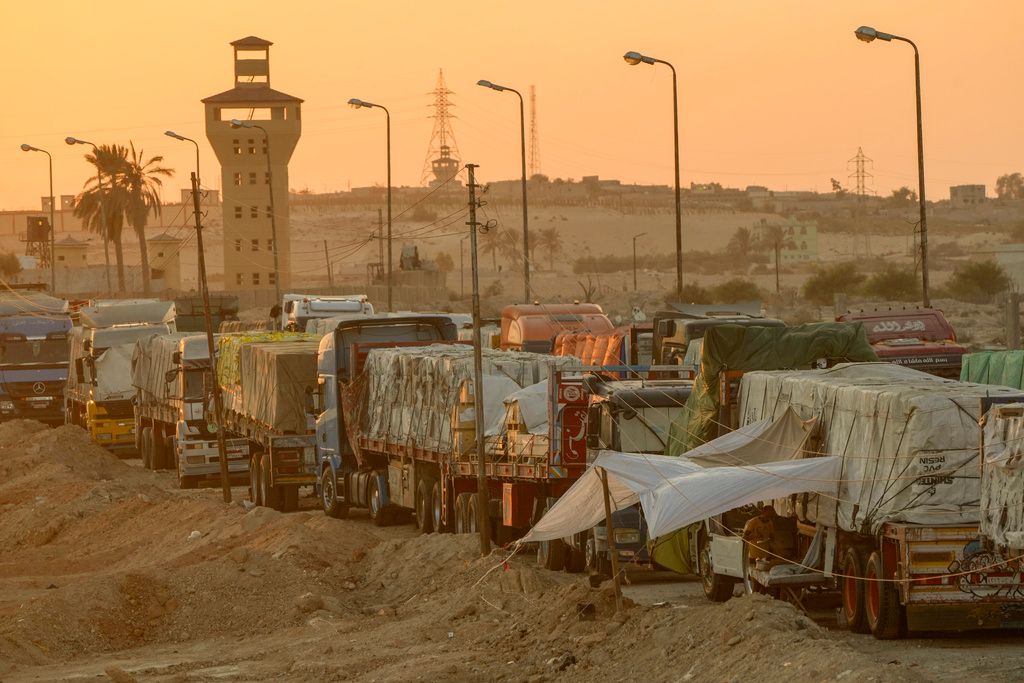
IMG_6062.jpeg

Trucks of humanitarian aids wait to cross the Rafah border crossing between Egypt and the Gaza Strip, in Rafah, Egypt, Monday, Sept. 9, 2024. (AP Photo/Amr Nabil)

Details about the strike in the Mawasi coastal community just west of Khan Younis that the Israeli military has designated as a humanitarian zone remained unclear. The area is home to many Palestinians displaced by the Israel-Hamas war in which the Israeli military has devastated the wider Gaza Strip after Hamas’ Oct. 7 attack on Israel.

Footage circulating on social media showed deep craters at the site of the attack, the strewn ruins around it covered in shredded tents, a bicycle and other debris. Rescue workers used shovels to shift through the sand. Bystanders used their hands to dig, illuminated by mobile phone light. At least one crater at the site looked to be as deep as 10 meters (32 feet).

The Israeli military described the strike as hitting “significant Hamas terrorists who were operating within a command-and-control center,” without immediately providing additional evidence.

The Palestinian news agency WAFA said dozens had been killed and wounded, without providing precise casualty figures. It described five missiles striking the area, cratering the ground.

The Israeli military said it used “precise munitions, aerial surveillance and additional means” it did not immediately describe to limit civilian casualties.

Gaza’s Health Ministry says over 40,000 Palestinians have been killed in Gaza since the war began. It does not differentiate between fighters and civilians in its count. The war has caused vast destruction and displaced around 90% of Gaza’s population of 2.3 million, often multiple times.

Hamas-led militants killed some 1,200 people, mostly civilians, in their Oct. 7 attack. They abducted another 250 and are still holding around 100 after releasing most of the rest in exchange for Palestinians imprisoned by Israel during a weeklong cease-fire last November. Around a third of the remaining hostages are believed to be dead.

Meanwhile, the United Nations agency in charge of aid for displaced Palestinians said the Israeli military stopped a convoy for more than eight hours on Monday, despite it coordinating with the troops.

The agency’s head Philippe Lazzarini said the staffers who were held had been trying to work on a polio vaccination campaign in northern Gaza and Gaza City. “The convoy was stopped at gun point just after the Wadi Gaza checkpoint with threats to detain UN staff,” he wrote on the social platform X. “Heavy damage was caused by bulldozers to the UN armoured vehicles.”

He said the staff and the convoy later returned to a U.N. base but it was unclear if a polio vaccination campaign would take place Tuesday in northern Gaza.

“UN Staff must be allowed to undertake their duties in safety + be protected at all times in accordance with international humanitarian law, he wrote. “Gaza is no different.” The Israeli military did not immediately respond to a request for comment.

Related Tags

world news
ADVERTISEMENT
.most-popular .layout-ratio{ padding-bottom: 79.13%; } @media (min-width: 768px) and (max-width: 1024px) { .widget-title { font-size: 15px !important; } }

{{ articles_filter_1561_widget.title }}

.most-popular .layout-ratio{ padding-bottom: 79.13%; } @media (min-width: 768px) and (max-width: 1024px) { .widget-title { font-size: 15px !important; } }

{{ articles_filter_1562_widget.title }}

.most-popular .layout-ratio{ padding-bottom: 79.13%; } @media (min-width: 768px) and (max-width: 1024px) { .widget-title { font-size: 15px !important; } }

{{ articles_filter_1563_widget.title }}

{{ articles_filter_1564_widget.title }}

.mb-article-details { position: relative; } .mb-article-details .article-body-preview, .mb-article-details .article-body-summary{ font-size: 17px; line-height: 30px; font-family: "Libre Caslon Text", serif; color: #000; } .mb-article-details .article-body-preview iframe , .mb-article-details .article-body-summary iframe{ width: 100%; margin: auto; } .read-more-background { background: linear-gradient(180deg, color(display-p3 1.000 1.000 1.000 / 0) 13.75%, color(display-p3 1.000 1.000 1.000 / 0.8) 30.79%, color(display-p3 1.000 1.000 1.000) 72.5%); position: absolute; height: 200px; width: 100%; bottom: 0; display: flex; justify-content: center; align-items: center; padding: 0; } .read-more-background a{ color: #000; } .read-more-btn { padding: 17px 45px; font-family: Inter; font-weight: 700; font-size: 18px; line-height: 16px; text-align: center; vertical-align: middle; border: 1px solid black; background-color: white; } .hidden { display: none; }
function initializeAllSwipers() { // Get all hidden inputs with cms_article_id document.querySelectorAll('[id^="cms_article_id_"]').forEach(function (input) { const cmsArticleId = input.value; const articleSelector = '#article-' + cmsArticleId + ' .body_images'; const swiperElement = document.querySelector(articleSelector); if (swiperElement && !swiperElement.classList.contains('swiper-initialized')) { new Swiper(articleSelector, { loop: true, pagination: false, navigation: { nextEl: '#article-' + cmsArticleId + ' .swiper-button-next', prevEl: '#article-' + cmsArticleId + ' .swiper-button-prev', }, }); } }); } setTimeout(initializeAllSwipers, 3000); const intersectionObserver = new IntersectionObserver( (entries) => { entries.forEach((entry) => { if (entry.isIntersecting) { const newUrl = entry.target.getAttribute("data-url"); if (newUrl) { history.pushState(null, null, newUrl); let article = entry.target; // Extract metadata const author = article.querySelector('.author-section').textContent.replace('By', '').trim(); const section = article.querySelector('.section-info ').textContent.replace(' ', ' '); const title = article.querySelector('.article-title h1').textContent; // Parse URL for Chartbeat path format const parsedUrl = new URL(newUrl, window.location.origin); const cleanUrl = parsedUrl.host + parsedUrl.pathname; // Update Chartbeat configuration if (typeof window._sf_async_config !== 'undefined') { window._sf_async_config.path = cleanUrl; window._sf_async_config.sections = section; window._sf_async_config.authors = author; } // Track virtual page view with Chartbeat if (typeof pSUPERFLY !== 'undefined' && typeof pSUPERFLY.virtualPage === 'function') { try { pSUPERFLY.virtualPage({ path: cleanUrl, title: title, sections: section, authors: author }); } catch (error) { console.error('ping error', error); } } // Optional: Update document title if (title && title !== document.title) { document.title = title; } } } }); }, { threshold: 0.1 } ); function showArticleBody(button) { const article = button.closest("article"); const summary = article.querySelector(".article-body-summary"); const body = article.querySelector(".article-body-preview"); const readMoreSection = article.querySelector(".read-more-background"); // Hide summary and read-more section summary.style.display = "none"; readMoreSection.style.display = "none"; // Show the full article body body.classList.remove("hidden"); } document.addEventListener("DOMContentLoaded", () => { let loadCount = 0; // Track how many times articles are loaded const offset = [1, 2, 3, 4, 5, 6, 7, 8, 9, 10]; // Offset values const currentUrl = window.location.pathname.substring(1); let isLoading = false; // Prevent multiple calls if (!currentUrl) { console.log("Current URL is invalid."); return; } const sentinel = document.getElementById("load-more-sentinel"); if (!sentinel) { console.log("Sentinel element not found."); return; } function isSentinelVisible() { const rect = sentinel.getBoundingClientRect(); return ( rect.top < window.innerHeight && rect.bottom >= 0 ); } function onScroll() { if (isLoading) return; if (isSentinelVisible()) { if (loadCount >= offset.length) { console.log("Maximum load attempts reached."); window.removeEventListener("scroll", onScroll); return; } isLoading = true; const currentOffset = offset[loadCount]; window.loadMoreItems().then(() => { let article = document.querySelector('#widget_1690 > div:nth-last-of-type(2) article'); intersectionObserver.observe(article) loadCount++; }).catch(error => { console.error("Error loading more items:", error); }).finally(() => { isLoading = false; }); } } window.addEventListener("scroll", onScroll); });

Sign up by email to receive news.