






 World
Trump makes false claims about federal response as he campaigns in area ravaged by Hurricane Helene
World
Trump makes false claims about federal response as he campaigns in area ravaged by Hurricane Helene
Trump makes false claims about federal response as he campaigns in area ravaged by Hurricane Helene


VALDOSTA, Ga. (AP) — Donald Trump repeatedly spread falsehoods Monday about the federal response to Hurricane Helene despite claiming not to be politicizing the disaster as he toured hard-hit areas in south Georgia.
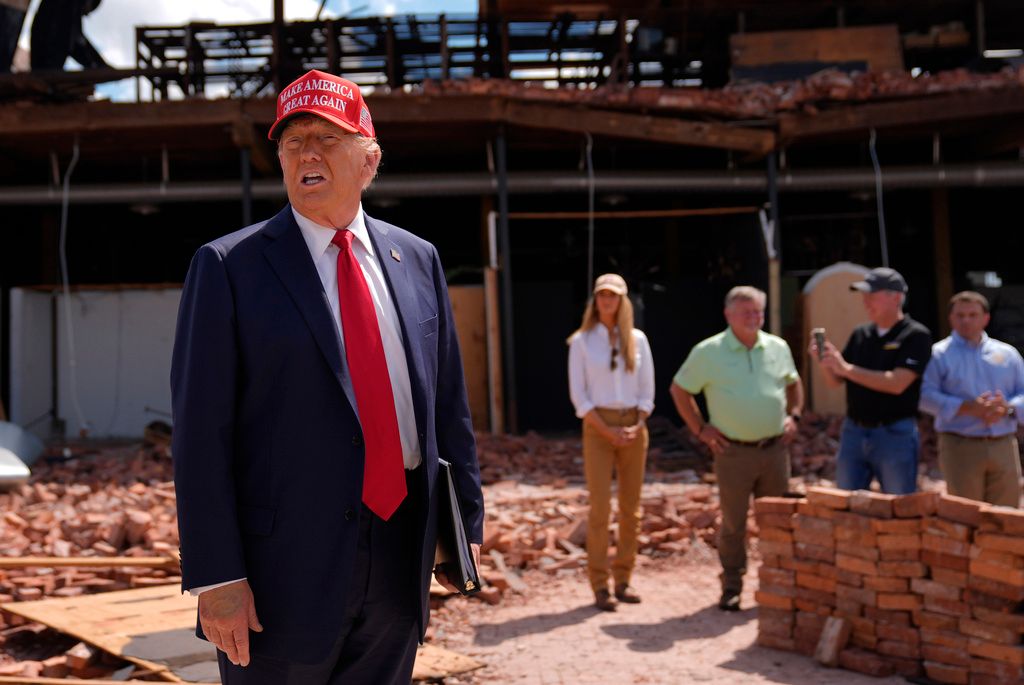
Republican presidential nominee former President Donald Trump speaks as he visits downtown Valdosta, Ga., a town that was impacted by Hurricane Helene, Monday, Sept. 30, 2024. (AP Photo/Evan Vucci)
The former president and Republican nominee claimed upon landing in Valdosta that President Joe Biden was “sleeping” and not responding to Georgia Gov. Brian Kemp, who he said was “calling the president and hasn’t been able to get him.” He repeated the claim at an event with reporters after being told Kemp said he had spoken to Biden.
“He’s lying, and the governor told him he was lying,” Biden said Monday.
The White House previously announced that Biden spoke by phone Sunday night with Kemp and North Carolina Gov. Roy Cooper, as well as Scott Matheson, mayor of Valdosta, Georgia, and Florida Emergency Management Director John Louk. Kemp confirmed Monday morning that he spoke to Biden the night before.
“The president just called me yesterday afternoon and I missed him and called him right back and he just said ‘Hey, what do you need?’ And I told him, you know, we’ve got what we need, we’ll work through the federal process,” Kemp said. “He offered if there are other things we need just to call him directly, which I appreciate that."
In addition to being humanitarian crises, natural disasters can create political tests for elected officials, particularly in the closing weeks of a presidential campaign in which among the hardest-hit states were North Carolina and Georgia, two battlegrounds. Trump over the last several days has used the damage wrought by Helene to attack Harris, the Democratic nominee, and suggest she and Biden are playing politics with the storm — something he was accused of doing when president.
Biden is defiant about spending time at his beach house
While the White House highlighted Biden's call to Kemp and others, the president faced questions about his decision to spend the weekend at his beach house in Delaware, rather than the White House, to monitor the storm.
“I was commanding it,” Biden told reporters after delivering remarks at the White House on the federal government’s response. “I was on the phone for at least two hours yesterday and the day before as well. I commanded it. It’s called a telephone.”
Biden received frequent updates on the storm, the White House said, as did Harris aboard Air Force Two as she made a West Coast campaign swing. The vice president cut short her campaign trip Monday to return to Washington for a briefing from the Federal Emergency Management Agency.
Trump, writing on his social media platform Monday, also claimed without evidence that the federal government and North Carolina’s Democratic governor were “going out of their way to not help people in Republican areas.” Asheville, which was devastated by the storm, is solidly Democratic, as is much of Buncombe County, which surrounds it.
The death toll from Helene has surpassed 100 people, with some of the worst damage caused by inland flooding in North Carolina.
Biden said he will travel to North Carolina on Wednesday to get a first-hand look at the devastation, but will limit his footprint so as not to distract from the ongoing recovery efforts.
During remarks Monday at FEMA headquarters, Harris said she has received regular briefings on the disaster response, including from FEMA Administrator Deanne Criswell, and has spoken with Kemp and Cooper in the last 24 hours.
“I have shared with them that we will do everything in our power to help communities respond and recover,” she said. “And I’ve shared with them that I plan to be on the ground as soon as possible without disrupting any emergency response operations.”
When asked if her visit was politicizing the storm, she frowned and shook her head but did not reply.
Trump partnered with a Christian charity to bring supplies
The Trump campaign partnered with the Christian humanitarian aid organization Samaritan’s Purse to bring trucks of fuel, food, water and other critical supplies to Georgia, said Karoline Leavitt, the Trump campaign’s national press secretary.
Leavitt did not immediately respond to questions about how much had been donated and from which entity.
Trump also launched a GoFundMe campaign with a $1 million goal for supporters to send financial aid to people impacted by the storm.
“Our hearts are with you and we are going to be with you as long as you need it,” Trump said, flanked by a group of elected officials and Republican supporters.
“We’re not talking about politics now,” Trump added.
Trump said he wanted to stop in North Carolina but was holding off because access and communication is limited in hard-hit communities.
When asked by The Associated Press on Monday if he was concerned that his visit to Georgia was taking away law enforcement resources that could be used for disaster response, Trump said, “No.” He said his campaign instead “brought many wagons of resources.”
Katie Watson, who owns with her husband the home design store Trump visited, said she was told the former president picked that location because he saw shots of the business destroyed with the rubble and said, “Find that place and find those people.”
“He didn’t come here for me. He came here to recognize that this town has been destroyed. It’s a big setback,” she said.
“He recognizes that we are hurting and he wants us to know that,” she added. “It was a lifetime opportunity to meet the president. This is not exactly the way I wanted to do it.”
Trump campaign officials have long pointed to his visit to East Palestine, Ohio, the site of a toxic trail derailment, as a turning point in the early days of the presidential race when he was struggling to establish his footing as a candidate. They believed his warm welcome by residents frustrated by the federal government’s response helped remind voters why they had been drawn to him years earlier.
Trump fought with Puerto Rico and meteorologists while president
During Trump’s term as president, he visited numerous disaster zones, including the aftermaths of hurricanes, tornadoes and shootings. But the trips sometimes elicited controversy such as when he tossed paper towels to cheering residents in Puerto Rico in 2017 in the wake of Hurricane Maria.
It also took until weeks before the presidential election in 2020 for Trump’s administration to release $13 billion in assistance for the territory. A federal government watchdog found that officials hampered an investigation into delays in aid delivery.
In another 2019 incident, Trump administration officials admonished some meteorologists for tweeting that Alabama was not threatened by Hurricane Dorian, contradicting the then-president. Trump would famously display a map altered with a black Sharpie pen to indicate Alabama could be in the path of the storm.