






 Business
British firm injecting $600-million investment for 40% stake in Terra Solar project
Business
British firm injecting $600-million investment for 40% stake in Terra Solar project
British firm injecting $600-million investment for 40% stake in Terra Solar project
Carving a niche to become the world's largest solar farm development


At A Glance
- The calculatedly chosen foreign partner in Terra Solar is a mammoth investor in the renewable energy (RE) space with $9.0 billion worth of pledged and committed projects for robust portfolio of 35 gigawatts (35,000 megawatts) all over the world.
- Given Actis' stature in reshaping energy landscapes globally, the Meralco group also views this joint venture deal as its ticket into becoming a 'big league' player in the world's RE development space.
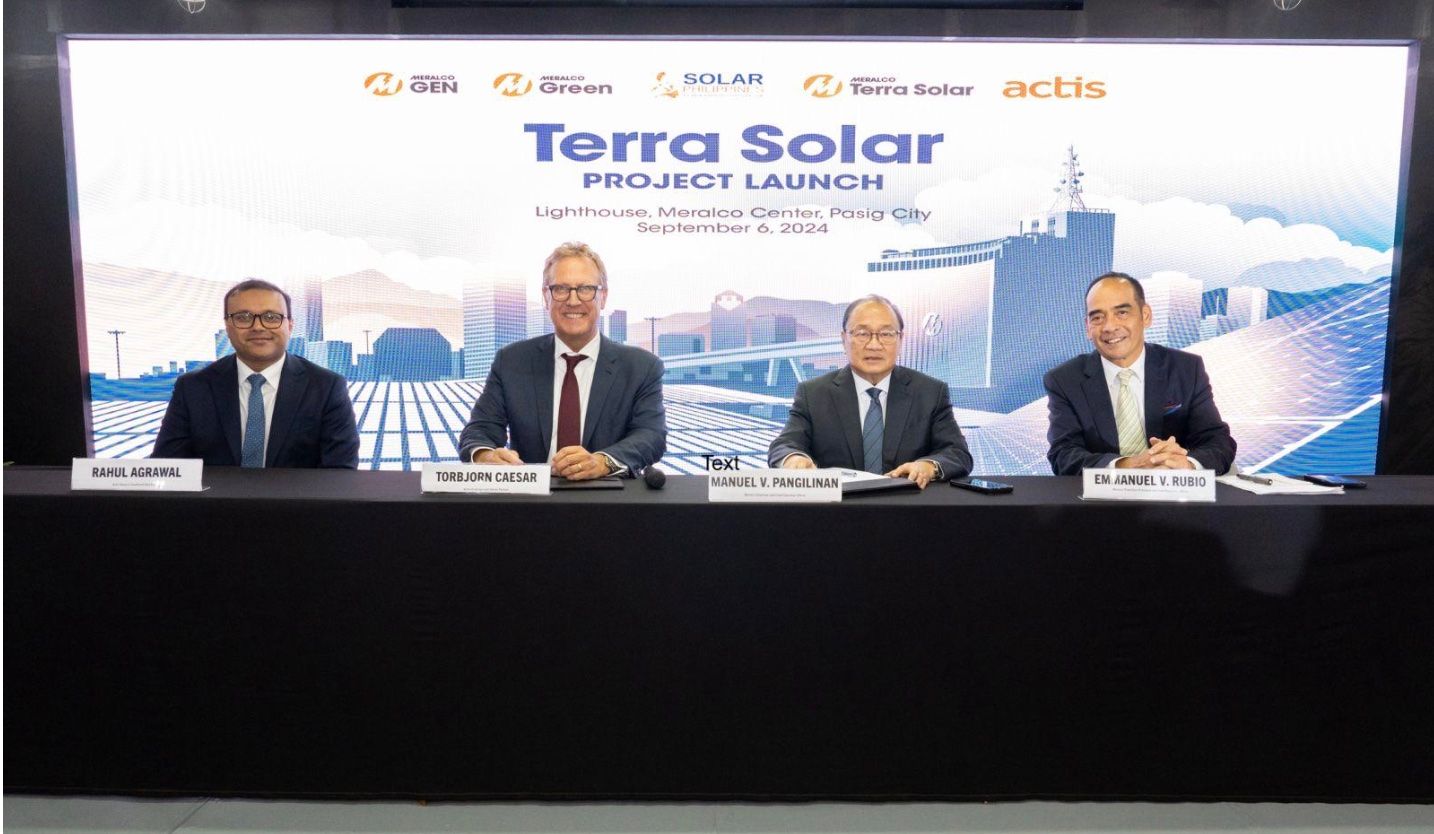
London-headquartered private equity firm Actis is injecting colossal investment of $600 million (approximately P34 billion) for its 40 percent equity acquisition in the $4 billion Terra Solar project being advanced to commercial fruition by SP New Energy Corporation (SPNEC) of the Manila Electric Company (Meralco) group, a cavernous development that will soon rise as the biggest solar farm installation in the world.
The calculatedly chosen foreign partner in Terra Solar is a mammoth investor in the renewable energy (RE) space with $9.0 billion worth of pledged and committed projects for robust portfolio of 35 gigawatts (35,000 megawatts) all over the world.
In an interview with reporters during the signing of the partnership deal on Friday evening, Meralco Chairman Manuel V. Pangilinan enthusiastically asserted that he’s very “satisfied” with the outcome of what he described as the “super deal” with its newly-minted global investment-firm partner.
“It’s all new money – we own 60%, and we put up initial money already on our equity, that’s in the game already” he stressed.
Pangilinan conveyed that the total value of the Terra Solar project will be a whopping P213 billion or roughly $4.0 billion; and that shall be bankrolled by 75% loan; while the 25% fraction of the equity will be coming from the Meralco group and its partner Actis.
The Terra solar project – which had been blueprinted for a two-phased development track in Nueva Ecija and Bulacan – will be of 3,500MW capacity for photovoltaic (PV) installations and 4,500 megawatt-hours of energy storage systems. Once on commercial stream by 2026 and 2027, the facility will deliver 850MW mid-merit capacity to Meralco.
Pangilinan similarly noted that he is equally elated by the fact that the freshly cemented transaction with Actis for Terra Solar were led by two first-rate Filipino deal makers – Joanne De Asis of Morgan Stanley and Lauro Baja III of UBS Asia Pacific.
“We worked with two globally preeminent investment bankers -- both Filipinos; and we’re happy to work with them… this is a ‘super deal’ for Meralco and super deal for the country,” Pangilinan enthused.
At this stage, the Meralco chairman also disclosed that Chinese firm Fujian Engineering and Meralco Industrial Engineering Services Corporation (MIESCOR) have already been tapped as contractors for the connection facilities that will wheel the generated capacity of the Terra Solar phase one facility once it reaches commercial operations in 2026.
For the supply of solar PV modules, Meralco PowerGen President and CEO Emmanuel V. Rubio indicated that they already received offers from Power China and Energy China; while for the energy storage component, there were already submissions from Chinese firms Huawei, Sungrow and Contemporary Amperex Technology Co. (CATL).
“We have not chosen the PV and energy storage suppliers yet. We are still negotiating,” Rubio said, although he hinted that decision point would also be reached soon.
"Super deal' investment for the Philippines
Actis Chairman and Senior Partner Torbjorn Caesar highlighted that their foray into the prodigious Terra Solar project serves as their solid financial commitment and bold statement of intent to become part of a massive energy infrastructure build in the Philippines that is out to transform international energy supply chains as well as catalyze technological innovations and capital formation in the solar development space globally.
“It is a massive project in a timescale that we have not seen before, but we have to make it happen…the world’s largest is not just impressive, but it is actually fantastic. From Actis’ side, we are very honored and excited to invest $600 into that,” he vouched.

Through the years, Caesar narrated that “we have invested in 60 markets and not in the Philippines so far, it was not because we haven’t seen the right risk return here, but now we see that – we see the economic development here, we see the demographics and the political leadership that creates transparency, that predictability for investors like us that come and the bold vision of getting renewable and sustainable infrastructure having a much more important role in the Philippines.”
He professed that their journey into becoming the Meralco group’s partner for the Terra Solar venture, went through “competitive and thorough process, but in that thorough process, we also got to know (Meralco) – and I think that is also important for us in having the confidence in making sure that we actually can deliver this project.”
Caesar said what their team brings to the table rests on the fact “we are a global investor, we are covering the markets for 85% of the world population. That is also where we have two-thirds of the investment opportunities in the infrastructure space.”
He averred that while any investors are “busy overbidding themselves for investments in the US and Europe,” Actis conversely turned its investment sight elsewhere in the Pacific, and that led to its discovery of the “fantastic opportunity in markets, and specifically now here in the Philippines.”
He further said “we can invest anywhere -- we can invest in Brazil, we can invest in Korea, we can invest in Egypt, however, we chose to invest here and that is an incredibly important – that there’s a global competition for capital and it’s coming because there’s right circumstances, there’s right set up to attract capital for like us here in the Philippines and we therefore take that as our part in building that renewable future in the Philippines.”
The investment of Actis in the Terra Solar project entails board seats that the partner-firms will likewise be deciding soon in their marriage.
Rubio emphasized that “to choose the right partner is not easy task, it was an extensive and rigorous process, one that required us to carefully consider every potential partner’s strength, values and track record.”
He qualified that “in Actis, we have found that ideal partner,” adding that “Actis’ reputation as a global investment firm - with its focused on sustainable infrastructure and more than $9.0 billion of capital pledge or committed in energy already precedes itself. It truly makes Actis the right partner for us -- the mutual respect and appreciation of the value that both of us will be bringing to the table.”
Given Actis’ stature in reshaping energy landscapes globally, the Meralco group also views this joint venture deal as its ticket into becoming a ‘big league’ player in the world’s RE development space.
“We expect the strategic partnership will not only put Philippines in the global spotlight, it will also thrust One Meralco into the international stage as a leader in the renewable energy space through its ownership of the world’s largest hybrid solar project which is poised to power more than 2.4 million households in the Philippines and displace 4.0 million tons of carbon dioxide every year,” Rubio exclaimed.
He further noted “we both see Terra Solar not just as a project, but as a calling – a calling to lead the Philippines to its journey toward energy security and contribute to its economic prosperity.”
Meralco group’s game-changing bet for Philippines green energy future
Beyond the euphoria of finally cornering its much-wanted partner in Terra Solar development, Rubio sounded off that the real part of the hard work is just about to begin as they will already move the project forward into its full commercial development cycle.
“Surely the road ahead will be challenging, but with Actis and everybody here by our side, I am more than confident that we will overcome the obstacles that will come our way,” he contended.
This early, he already rallied the team spearheading the project – under the leadership of SPNEC Chief Operations Officer Dennis Jordan – for their unshakeable commitment and to be prepared for storm of obstacles that could really test them technologically, logistically and even mentally when it comes to forward-decision making during the development phase.
“To the project execution team led by Dennis Jordan, the success of Terra Solar rests in your hands and I urge you to approach this project with the same dedication, passion and excellence that have brought us this far,” he declared.
Rubio reiterated that “the sheer scale of Terra Solar is too unprecedented -- 3,500 hectares of land or equivalent of 4,900 football fields … a true testament of our shared commitment to scale and ambition, but what truly sets Terra Solar apart is not just its size, it is the potential impact it will have on the Philippine renewable energy landscape.”
He expounded “this project will be a cornerstone of our nation’s pursuit of energy security as it provides clean power to Filipinos -- it will reduce our reliance on fossil fuels, avoid greenhouse gas emissions and contribute to the country’s economic growth by creating jobs and fostering new commercial activities in the communities we serve.”
The Meralco PowerGen executive articulated “such grand vision requires not just ambition, it requires action and the right partners to shape our vision, share our values and commitments which is a greener and more sustainable future.”