







Dutertes mourn Davao City Barangay Affairs Office head's death
By Ivy Tejano


DAVAO CITY – Rep. Paolo Duterte and his family mourned the death of Barangay Affairs Office head Marius Salvalion Garcia who died at the age of 69 due to acute ulcer.
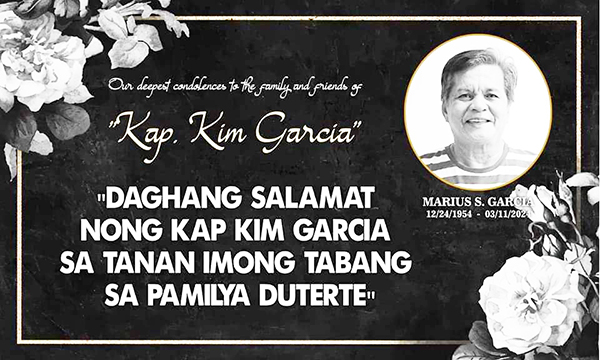
Aside from Rep. Duterte, his father and sister, former President Rodrigo Duterte and Vice President and Education Secretary Sara Duterte, visited the last day of Garcia’s wake on March 16.
The Dutertes sympathized with the Garcia family.
Garcia, fondly known as Kapitan Kim or Kap Kim by constituents and colleagues, was remembered as a genuine public servant whose impact has been enduringly noteworthy in the lives of numerous groups and individuals.
Rep. Duterte recalled that whenever there is a concern in the barangay early in the morning, Kap Kim and even the staff from the PPP would wake up to address the matter.
He said Garcia constantly proved the role of a public servant. “Dako kaayo kawad-on sa siyudad sa Dabaw si Kap Kim. Ang siyudad nagapasalamat sa imoha, sa imong kaayo, sa imong pag-amuma kanamong tanan (The city of Davao will miss Captain Kim. The city is thankful to you for your kindness and care for all of us),” Rep. Duterte said.
Rep. Duterte’s son Omar, chairman of Barangay Buhangin Proper here, recalled his time with Garcia. He said there is never a day when they do not burst into laughter and keep joking around all the time.
Omar said that every time Garcia visited the barangay, he always succeeded in reminding and advising him on several things, mostly when he was still a neophyte in the office. He added that Garcia advised the barangay councils to cooperate with and guide him.
“Sa tanan gitudlo niya sa ako, tambag, kung asa man ko maabot sa kinabuhi madala nako na. Mao dakong salamat kang Kap Kim ug sa pamilya niya (In everything he teaches me, his advice, I will always carry it wherever I go. I am deeply grateful to Captain Kim and his family),” Omar said.
Wilfredo Villarica, chief of staff of Rep. Duterte, described Garcia as a mentor because he has been in the barangay affairs and political scene for a long time and that he learned a lot of things from him.
Garcia is a hardworking public servant who works even when sick, Villarica said. He added that the former is so dedicated to his job that the entire office and the Duterte family are grateful and honored to have him.
“Kap Kim has served the Duterte family for a long time. So, he is like a family. The family considers him as a family, which is why his death is painful to the Dutertes. Kap Kim is such a good individual who is admired by many,” Villarica said.
Crisking Candia of the Barangay Affairs Office described Garcia as a public servant whom people can rely on. She said he had helped people, and he would make some of his valuable things collateral to assist them.
As a head of the office, Candia said, Garcia was a loyal, focused, strict, disciplined, and time-conscious leader regarding all the work. She added that he was like a father – a food provider, a good adviser, and a considerate man – once they completed all the tasks.
In a phone interview, Barangay 34-D Chairman Erlan Guevarra said no one can match Garcia’s generosity to the people. He added that if he is going to rate how Garcia was doing as a barangay officer, a colleague, a friend, and a father, he would give him more than 100 percent.